March 25th–Day of the Unborn Child and
Traditional Annunciation Feast of Christ's Conception
Celebrating the Incarnation–9 months before Christmas
This site was
developed to advance the movement toward international recognition of March
25th as the "Day of The Unborn Child," and equally to promote among
Christians the observance of this historical feast day of the Incarnation
honoring Christ’s conception (once celebrated as New Year’s Day) now known as
the Feast of the Annunciation. The
significance of the date can be more readily understood if we highlight the
fact that it comes nine months before the day commemorating the most celebrated
birth in Western civilization known throughout the world as the December 25th
feast of Christmas. Regardless of
whether one emphasizes the secular or religious aspects of the March 25th
memorial, the symbolic interval of a full-term pregnancy reminds us of the
reality, importance, and dignity of human life from day one at the moment of
conception.
 VirtualAdventWreath w/ Annunciation greeting
Twitter, Facebook & NEW Archived
Site
Free E-card--For Annunciation &
Christmas
Free Prayer Card & Brochure Downloads
Note on the Artwork (A Second Halo)
Missed the Day & Events?--Year-Round Ideas
9
Months 4 Life: Mar.25-Dec.25
List Your Event / Share a Suggestion
Web Calendars~Share Feast Day Reminders
New: Life Is a Miracle pdf~Family
Mar.25 Guide
NEW: Crochet
Wrist-Rosary Outreach From Annunciation to Christmas
Rosary Making and Giveaways are a fun and positive way to
celebrate the Annunciation and Christmas connection as well as providing a
natural invite to Mass and church activities.
(The
Annunciation/Conception of Christ is the first of the 20 Rosary subjects for
meditation, and the second–the Visitation of Mary to Elizabeth–is also the
prenatal meeting of Christ and John the Baptist via their mothers, both
"with child.") Many
churches encourage parishioners to invite family and friends back to the faith,
particularly grandparents, and mailable bracelet Rosaries that slip in a
birthday card are an easy way to do so.
For more including a downloadable instruction sheet, click the following
link: Crochet
Wrist-Rosary (Mail-Safe--1 Stamp)
NOTE:
It is important to make a concerted effort to reestablish celebration of holy
days in the wake of the events of 2020, both public and private family
gatherings. Covid19 restrictions and
lockdowns had a suppressive effect on worship services and public celebration
of feast days that can have a lasting impact as the tradition of annual events
is broken and many longstanding events are not aggressively publicized but rely
on the reinforcement of tradition to preserve these special occasions for
future generations. As such it is
essential to renew our commitment to celebrating the Annunciation and Day of
the Unborn Child. Keep in mind the
following tips to encourage attendance:
Choose a
time period unlikely to conflict with other events, before sundown if
possible (when older drivers feel comfortable coming and going). To offer evening participation consider a
multipart event with standalone portions of the program that allow people to
come either in the day or after work--as in 12 hours of adoration. Choose a convenient location easy to
get to, with ample parking. Make sure
to publicize your event, be it simple refreshments after Mass or a formal
dinner fundraiser. In addition to
putting a notice in the bulletin, posting fliers, and having the
pastor include it in the announcements after services, please make an
effort to have a noticed published on a website -- not just a .pdf
(these must be downloaded and are hard to search) but also on a standard
webpage that can be viewed in a Web browser, for this will make it much easier
for people using a search engine to find your event. In the web version of the notice remember to put the year and keywords
for Feast of the Annunciation and Day of the Unborn Child and also mention the
nearby towns and cities in order to attract people in other localities. For example, if the location of your event
is Lockport, NY -- an ad might say:
Looking for an Annunciation/Day of the Unborn Child event in the Buffalo
- Niagara Falls area? ~ Join Us at…"
Another helpful way to add these search-friendly keywords is to include
brief driving directions to church/venue from various nearby cities and towns.
List An Event / Share a Suggestion
Visit our Local & National Events page to check current listings by state and city. If there is a special upcoming Annunciation or Day of the Unborn Child event that you would like to see listed, or if you would like to share ideas and traditions for celebrating the day, contact us with details (including website links if possible) at info@DayOfTheUnbornChild.com.
Follow Us on Twitter @March25info and on Facebook at AnnunciationDayMarch25 ~ Plus [NEW] Link to Archive Site for DayOfTheUnbornChild.com
If you would like more frequent updates than the mailing list provides, follow us on Facebook and/or Twitter for updates on Day of the Unborn Child events, and also year-round alerts for TV specials on Annunciation shrines/pilgrimages, and Spiritual Adoption/"9 Months 4 Life" prayer intentions and "25th of the Month Club" ideas each 25th. To visit and "Like" our page on Facebook go to facebook.com/AnnunciationDayMarch25 and to sign up for tweets just click this link: Follow Us On Twitter @March25info -- and make note of this alternate archive link to older versions of our site -- https://web.archive.org/web/*/http://dayoftheunbornchild.com
More on Using Web Archive:
Bookmark/Favorite the Archive Site for DayOfTheUnbornChild.com
The archive link is important for any site that includes hard-to-find information, and if technical problems or site upgrades prevent you from accessing our website, an older version will still be available at what is known as the Wayback Machine -- basically an archive of websites. Just go to the link: https://web.archive.org/web/*/http://dayoftheunbornchild.com -- (you can then click your device's option/icon to "star," favorite, or bookmark the site -- or just take a screenshot of this paragraph). Once there choose the most recent version of the site (slide towards the current year and choose the most recent year that shows saved versions) and then scroll to the most recent month, click the date, and then click the link to the snapshot of that date. You should get an older version of this site to browse through. The text, information, and graphics will be there, and the internal links and navigation within the site should work, but please note the events listings won't be current and some of the outside links may not work -- but the majority of the content will be there. (The Wayback Machine is useful for research on many topics where up-to-date information is not essential, and for accessing hard-to-find info on old websites no longer currently hosted on the web).
Share a
Web Version of our Mini-Calendar--Opens/Prints In Your Browser--An Easy Way to Highlight the Holy Days
(Dec.25/Jan.1/Mar.25)--A Link to Print/Share
A
web-based version of our calendar card downloads from the Ideas page makes it
easier to share/print these useful reminders of the
Annunciation/NewYear-Christmas Holy-Day Connection: Both the One-Page and the smaller 4-Per Page versions have the
heading "A Blessed Annunciation + 9 Months = A Merry Christmas" with
the dates next to each feast name as well as circled on the calendar, with info
on the Annunciation as the old New Year's Day below.
For the Mini Calendars click: http://www.dayoftheunbornchild.com/MiniCalendarsLinkDec25Jan1Mar25.html -- mini calendars print 4 to a page.
For One-Sheet Calendars click: http://www.dayoftheunbornchild.com/SheetCalendarLinksDec25Jan1Mar25.htm
Use Our Free E-cards for Both the Annunciation and Christmas. Send An E-mail to Mar25Dec25ecard@dayoftheunbornchild.com and you will receive our dual-season e-card to forward to family and friends.
Since you will receive our e-card in your inbox you can use your own e-mail program and contact-list/address-book to forward it to as many recipients as you like, as often as you like -- and keep it to use on both holidays. Also downloadable as note/post-cards, the festive design covers both the springtime and the winter feasts -- so you can raise awareness about the significance of March 25th while checking off your Christmas card list. Click HERE for full details and tips and other cards and banner options.
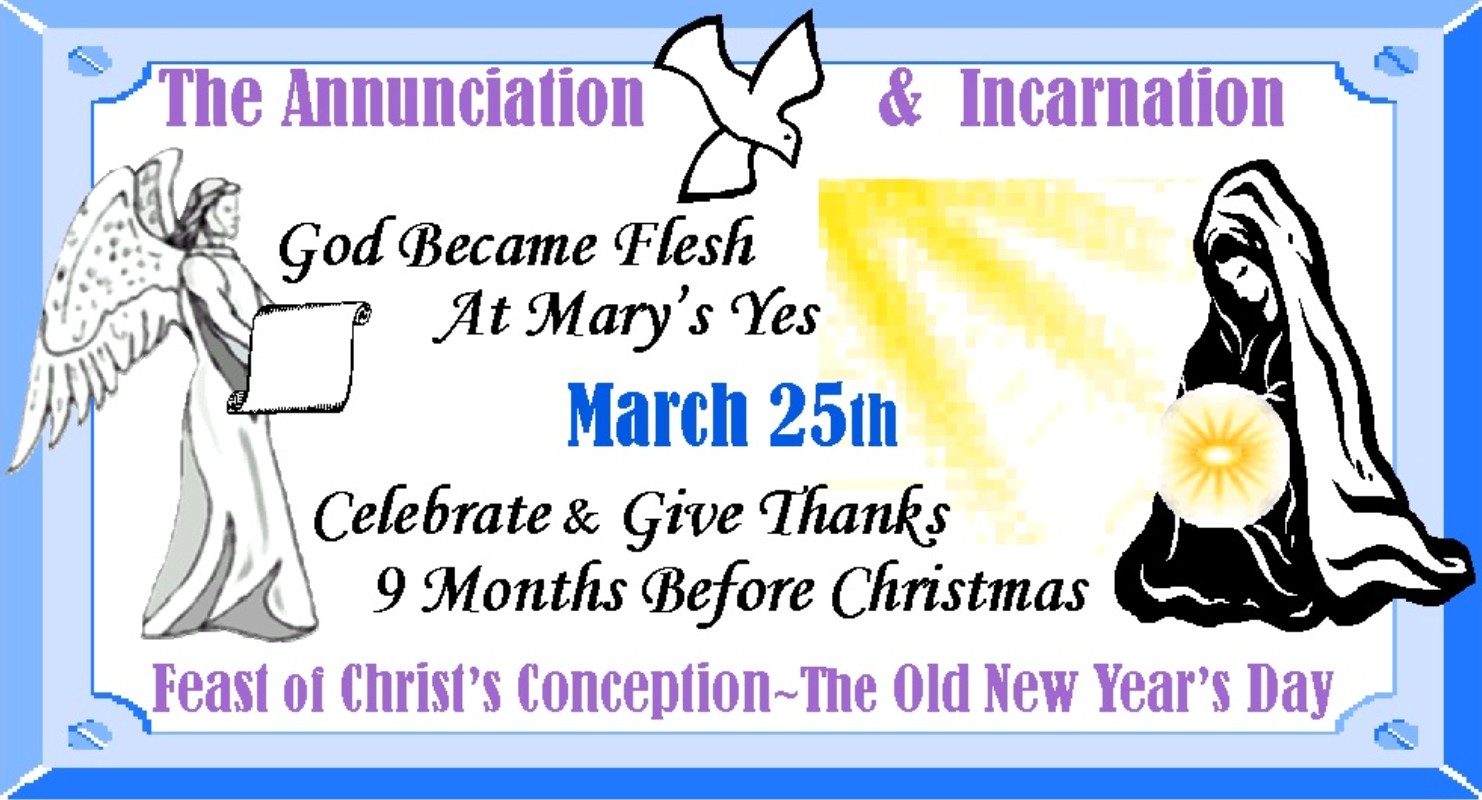
Use Our Seasonal Banners in E-mails, Blogs, and Websites to Highlight the Annunciation--or Print as Signs, Envelope Seals and Note/Post-Cards
Click HERE to view our selection of banners and instructions on using them to promote the Annunciation as the Feast of Christ's Conception/Incarnation or as Day of the Unborn Child and the start of a "9 Months 4 Life" period of Spiritual Adoption prayer. The page also features multi-season banners to highlight the Annunciation/Christmas/New Year's connection during the holiday season or year round.
Questions & Answers
Why use a Christian feast to promote the universal cause of
unborn children?
Why is the Feast of the Annunciation so important
to the pro-life movement?
Can secular pro-life groups honor March
25 simply as the Day of the Unborn Child?
Why isn't the feast honoring Christ’s
conception more widely celebrated?
What if my church moves this
year’s Annunciation feast to a day near the 25th?
How can we use the day to teach children
respect-for-life before the “facts of life” talk?
Was Christ conceived on March 25th?
If the Annunciation is the feast of the
Incarnation, how should we view Christmas?
Which denominations have the Annunciation feast
as part of their tradition?
Is the Annunciation a feast of Christ or
a feast of Mary?
What can I do the rest of the
year if the day has already passed?
Why use a Christian feast to promote the universal cause of unborn children? Why not choose a new date for a secular Day Of The Unborn Child?
It
would be hard to find a date that has more universal import than the
Annunciation feast day of March 25th (once observed as New Year's Day) in its
symbolic link to a historic birthday celebration known worldwide. Christmas is recognized around the world and
its celebration transcends cultural, racial, national and class
divisions--therefore the feast day that precedes it by the length of a
pregnancy is an ideal choice for a cross-cultural memorial for the unborn that
can similarly transcend varying faith traditions. In fact, the Vatican.va page promoting the Annunciation feast as "The Day of the Unborn
Child" notes that when the movement began in Argentina the official 1999
proclamation was made in the presence of representatives from the Orthodox,
Anglican, Evangelical, Jewish, and Muslim faiths. Likewise, the date of the Annunciation as "Day of the Unborn
Child" can be honored by those of no particular faith tradition who
advocate the right to life for secular philosophical reasons. Clearly there is no absolutist line of
separation between the overlapping spheres of state and faith-influenced
culture based on the precedents we’ve already set in national holidays like
Christmas and the way we measure time.
Even the most secularized nations and governments use a calendar that
has the approximate date of Christ’s birth as its starting point. Atheist scholars accept the conventional
division of history into B.C. (before Christ) and A.D. or Anno Domini which
means “in the year of the Lord.” As
such, governments that officially adopt this date as a day of remembrance for
the unborn are well within the norms of what is already practiced in modern
democratic nations. Even if March 25
were not a Christian feast, it would make perfect sense to remember unborn
children on the day that falls nine months before the international celebration
of the most widely recognized birth in Western civilization. It should be obvious that the decision to
choose this day for a national observance reflects a common cultural language
and in no way approaches a “theocracy.”
In rightly affirming the protection of unborn children as a secular
cause, it should also be noted that much of what we take for granted as civil
human rights (i.e. laws against infanticide) and humanitarian progress
(provision for the poor) grew out of 2000 years of Christian moral philosophy
and charitable works. Just as the
season of Christmas honoring the birth of Jesus has become a time for
cross-cultural charitable endeavors to help children of all faiths, the
Annunciation feast date as "Day of the Unborn Child" can become an
annual focus for solidarity in our charitable action toward children in the
womb.
Why is the Feast of the Annunciation so important to the pro-life movement?
In
recent years perceptive pro-life parents began annual celebrations of their
children's "First Days" nine months before their birthdays--recognizing
that if everyday practices don’t reflect the reality of their beliefs they send
a counterproductively mixed message. At
this same time, some Christians, particularly those in the pro-life movement,
began to recognize that Christ's “first day” of human life passed by every year
virtually unnoticed by the majority of believers; commonly there was no obvious
celebration either private or public--those churches that observed the feast
had services for the day, but attendance was generally no greater than a normal
daily mass. And this was no ordinary
“first day,” for unlike the natural conception of children who are created
beings, this was the moment that Christ the Eternal Word became flesh by the
power of the Holy Spirit--it was the “first day” only of His human earthly life
that he shared with us. This is what
Christians call the Incarnation--the moment God became man. As the word “incarnate” (to be made flesh)
implies, this was accomplished not when Jesus reached adulthood, or was revealed
to the world at his birth--it happened when he took on human flesh at his
conception in Mary’s womb. The
Incarnation as an event had a specific time and place, as simply stated on a
plaque in Nazareth’s Church of the Annunciation: "Verbum caro hic factum est"--"the Word was made
flesh here." The pro-life
significance of this statement in the context of the Annunciation is addressed
in an American Life League article (on cloning) that reprints the first
chapter of professor John Saward's "Redeemer in the Womb." In reflecting upon this momentous occasion,
we can find inspiration to combat the “out of sight out of mind” tendency that
attaches itself to all hidden realities, even the central reality of the
Incarnation. If the Christian
community as a whole does not consistently recognize and honor the conception
and prenatal life of Christ who is God, then it should come as no surprise that
the secular world has so little regard for the newly conceived life of an
"unplanned" child, who is neither divine nor anxiously awaited nor
announced by angelic herald, but is simply unwanted, like so many others. It is essential for all Christians to not
only remember but celebrate the fact that the Word was made flesh in Nazareth
nine months before Christ's birth in Bethlehem. Fortunately it is not necessary to wholly invent a “first day”
tradition for Christ. Early in
Christendom (probably the 400’s) Christ’s first day was already
memorialized. Now known as the Feast of
the Annunciation, officially it is still the principal feast of the
Incarnation, and was universally celebrated by the 600’s. In the past it had been named Festum
Incarnationis and Conceptio Christi--titles that highlight the fact that
Christ's conception/Incarnation is being commemorated. Celebrating March 25th in remembrance of
this reality (and as The Day of the Unborn Child as many nations are now doing)
will be a wonderful spiritual counterpart to the celebration of Christmas,
which has unfortunately become so commercialized and secularized. Keep in mind also that the Annunciation is
not only one of the most frequently depicted events in art, but is also the
most frequently depicted conception. It
is quite remarkable that an event that takes place unseen inside the human body
should become one of the most popular iconic themes for a visual medium like
painting. Wouldn’t it be tragic if such
potentially powerful pro-life imagery were lost on even the most faithful
Christians because they were never taught the significance of the Annunciation
as the occasion of Christ’s Incarnation and therefore don’t see its powerful
pro-life implications. (For more on the
Annunciation in art, read A Note On The Artwork). In sum, raising awareness of the meaning of
the Christian feast whose date has been adopted for a secular pro-life day of
remembrance complements that cause, just as Christian clergy assisted secular
civil rights workers in the 1960’s. The
participation of an ordained Christian minister like the Rev. Martin Luther
King, Jr. (who frequently referenced God in his civil rights speeches) did not
limit his movement, or make voting rights an exclusively religious issue. Likewise Christian understanding of the
Annunciation will not interfere with but may actually be a necessary step on
the way to establishing the Day Of The Unborn Child as an annual secular
memorial.
Can secular pro-life groups honor March
25 simply as the Day of the Unborn Child?
Certainly
a pro-life political organization or pro-life pregnancy center that serves all
faiths can honor this date as the “Day of the Unborn Child” without any overtly
religious promotion of its roots as a Christian feast. Just as many secular organizations choose
Christmas (feast of the Nativity) for special charitable works and outreach,
secular pro-life groups can choose the date of the Annunciation feast for a
special event to raise funds, start a baby item donation drive, or to launch a
new educational campaign such as the FirstDays
and +9
(plus nine) programs. In the case
of secular activism these can be promoted simply as “Day of the Unborn Child”
events. However those involved with the
activities should be aware of the origins of the day and be prepared to answer
any questions about why that particular date was selected for pro-life
action--the answer can be simply stated as follows: Just as Christmas is a time of special outreach to children among
even secular charities, this date of Annunciation Day honoring Christ's first
day in the womb (nine months before Christmas) has been chosen as a special
time to help unborn children.
It
should also be recognized that the staff of these organizations are most often
people of faith, and that although direct evangelization may not fit with that
group’s particular mandate, questions that arise from attendees, participants,
and clients themselves are perfectly legitimate opportunities to share a bit of
Christian history as it relates to Christ’s conception as the Incarnation, and
for the many Christians who work in such organizations to share their belief in
that central tenet of the Christian faith.
As noted at the end of the previous answer, though the mission of
secular and religious movements is not identical, there has traditionally been
a broad area of overlap in which both causes are enriched by each other’s
efforts.
Why isn’t the feast of Christ’s conception more widely celebrated? What could be more central to Christianity than the Incarnation?
The most important event of your life is your conception--for that is what makes all the rest possible, including your salvation. Though Christ is the eternal Word -- the uncreated second person of the Trinity, had he not become that tiny embryo at a particular point in time, there would be no atonement on the cross, and no resurrection from the dead. But the conception of Christ is infinitely more than just the beginning of a pivotal trajectory -- it is the instant God became man -- when the Word was made flesh -- the most mysterious and awe-inspiring moment of history. To introduce the subject of celebrating this event, it is important to note that the March 25th Annunciation Day feast once had the most pointed and widespread celebration possible for it marked the beginning of the year in the old pre-Gregorian calendar, but gradually in the 16th to 18th centuries, countries began to adopt the new January 1st New Year’s Day. This loss of secular significance was compounded by several factors impacting the awareness of its religious significance. Post-reformation approaches to de-emphasize celebration of holy days, particularly those that are Marian, may have marginalized the Annunciation in churches that mistook the day as a feast only of Mary rather than its true status as Incarnational feast of Christ's conception. Related to this factor is the fact that titles for the feast, both formal and informal, have varied throughout history. Names may not change the nature of things, but they do direct our attention. Two of the earlier titles--Conceptio Christi (Conception of Christ) and Festum Incarnationis (Feast of the Incarnation)--made it clear that Christ’s Conception/Incarnation was being commemorated. Although “Incarnation” is still occasionally used (as by Pope John Paul II) to refer to the feast, the more common title “Annunciation” is named after the angel’s message--only the first of the events in the Biblical account of Jesus’ conception, all of which are to be commemorated on the feast day. Likewise, although the current title "Annunciation of the Lord" focuses on Christ, the previous title "Annunciation of the Blessed Virgin Mary" highlighted the Marian aspect of the feast, as did the informal "Lady's Day" (Our Lady's Day) used in England. Moreover, for Catholics--although it retains the high rank of a solemnity (from “sollennis” meaning “annual”)--the feast is no longer a universal holy day of obligation in terms of required Mass attendance, though it is remains so in some nations. As such, though in a liturgical sense it is widely celebrated geographically, the non-obligatory status makes it a challenge to get large numbers to attend and to promote understanding of the centrality of the feast and its full meaning--this is especially difficult if people assume they are only celebrating the delivery of a message albeit a heavenly one. As for the reasons mass attendance is not obligatory, it is important to remember that it once was, along with many other feasts. The change came in 1911 when Pope Piux X decreased the number of required holy days of obligation to attend mass from 36 to just 8 (later raised to 10 in 1917), and the Annunciation was not included in the reduced list. The explanation given is that this was done to make Vatican standards consistent with what local bishops had already done, as they had some local control over Holy Days and could petition for exemptions for some while elevating others or making adjustments to how and when they are celebrated. Many had already stopped requiring Mass attendance on the Annunciation and various other days. But that desire for greater consistency is a practical concern and a technical explanation that doesn't answer the philosophical question of why the Annunciation feast was left off the short list of required Holy Days of Obligation that were retained, or why the trend to make it optional had started in so many locales in the first place. Likely the desire to lighten obligations to make it easier to practice the faith was one consideration. Another theory for why the decision was made in the Catholic Church to make Annunciation mass attendance optional is the idea that holy days of obligation should concentrate on feasts that are distinctively Catholic (as was done with the obligatory Marian holy days) which might otherwise fall by the wayside in the larger culture with varied faith traditions; the assumption being that the Annunciation feast of Christ's conception/Incarnation is so important that it will be celebrated by all Christian denominations creating a general cultural awareness strong enough so that people won't need to be told to attend church, especially since the Annunciation is described in the Bible. However, in our modern secular age that assumption can no longer be made; the culture did not maintain the Annunciation's prominence, while Christmas which had prominence via cultural traditions was nevertheless retained for obligatory mass attendance. The obligation likely helped Christmas maintain a spiritual sense within a secular culture, for even though the prominent traditions of Christmas and cross-denominational celebration popularized the feast to the point where people might be expected to attend church even if not required to do so, maintaining its status as a holy day of obligation surely helped stem the erosion of church attendance on and religious understanding of the feast of Christ's birth. Another theory suggests that the Annunciation receives less emphasis than Christmas because Annunciation falls within Lent--a penitential season that tends to subdue celebrations--and this most certainly has had some effect particularly in recent centuries as Annunciation Day as a holiday has faded from the wider culture. However, it is also the case that the serious tone or penitential practice of the liturgical season can be suspended for a day, as happened historically when Annunciation Day was celebrated as New Year's Day during Lent, and as happens today during Lent in Laetare Sunday to provide a respite, and on Gaudete (meaning joyful) Sunday during Advent which was once a penitential season leading to Christmas--so it is certainly possible to have a true celebration of the Annunciation during Lent compatible with the traditions of the season. In fact, Canon 1251 includes an exemption from abstinence from meat when a solemnity feast falls on an ordinary Friday in Lent, as the festive nature of the day overrides the penance of Friday (but not Good Friday). The influence of Lent leads into the next factor to be considered--competition for time and attention during the Lent/Easter season; far more than any conscious decision to tone down the Annunciation celebration, today it is far more likely that the feast is simply being overlooked among the many worthy Lenten/Easter practices and events. Due to the season in which it necessarily falls, without a determined effort to highlight its importance the feast is often lost among the Holy Week observances leading up to Easter. Additionally, measures to avoid Lent and Easter-season conflicts by moving ("transferring") the feast one or more days in those years (sometimes into April), reasonable as they may be in theory, have the practical effect of obscuring the nine-month interval before Christmas that would underscore the day’s significance (although a church or diocese can take opportunities on both the 25th and the transferred day to teach via the mass homilies about the usual date's meaning and the reason for the current year's "transfer.") Another important factor is the confusion stemming from the fact that many people mistakenly believe the day Jesus was conceived is already being celebrated on the Feast of the Immaculate Conception, when in truth this is the Catholic feast for the day Mary was conceived; understandably, if they are not acquainted with the practice of celebrating Christ’s conception on the Annunciation feast, they may simply assume it must be celebrated on the feast of the “Immaculate Conception”--a term which, to add another complication, is indeed used by some Protestant denominations to refer to the conception of Jesus. [See the "Use Web Banners" page for a memory-aid you can share to distinguish the two.] To summarize the factors that explain why the Annunciation isn't more widely celebrated: The Vatican level reduction of holy days of obligation that made Annunciation mass attendance optional for the sake of consistency based on local practices and exemptions already established perhaps in part to make practice of the faith easier, combined with the switch to the Gregorian calendar with its January 1st New Year, the varying names for the feast, post-Reformation de-emphasis of holy days particularly one often mistaken for a purely Marian feast, competition for time and attention in the Lent/Easter season, periodic celebration of the feast on varying "transferred" dates, confusion of the Annunciation with the feast of Mary's Immaculate Conception, as well as general cultural secularization, have all played a role in suppressing awareness of the Annunciation's import--but the good news is that these can be mitigated and remedied by education and enthusiasm for restoring the feast to its former place of prominence in Christian life. Clearly there is much need for education and clarification on these matters, and widespread observance of the traditional March 25th Annunciation feast date not simply as the celebration of the Incarnation, but additionally as Day of the Unborn Child not only helps to focus on the plight of the unborn, but also helps Christians to more fully understand and appreciate the true Incarnational meaning of the Annunciation and its feast as a day set aside to celebrate Christ's conception.
What if my church has moved this year’s Annunciation feast to a day near the 25th?
Though
the traditional Annunciation feast date is March 25th, the celebration of the
Annunciation feast day is often moved one or more days in years when it would
conflict with other important holy days in the season of Lent and Easter which
fall on specific days of the week and therefore on different dates of the
month. The Roman Catholic Church for
example, transfers the feast in these cases; Anglicans and Lutherans also
transfer the feast in years with a conflict, but they may differ in the
criteria used for whether or not to transfer and what day to transfer it
to. Different formulas for moving the
feast in years with Lent/Easter conflicts have been used in the past. The current Roman Catholic practice is that
if the March 25 Annunciation falls on a Sunday of Lent then it is "transferred"
to the following Monday, if it falls on Palm Sunday it is celebrated on the
preceding Saturday, and if it falls during Holy Week or the Octave of Easter it
is transferred to the Monday of the Second Week of Easter. As such, oftentimes it is celebrated several
days after the 25th, even into April.
In transfer years, the church bulletin should explain the reason for the
change in that particular year, as well as the significance of the usual March
25th date, which can also be reinforced to the congregation in the feast day
sermon. See our web banner page
for a general graphic to use in any "transfer" year as well as a banner for the specific
date if it's moved. Note that the
Eastern churches (Eastern Orthodox, Oriental, Eastern Catholic) generally do
not change the day, but commonly use April 7th for the feast as this is their
equivalent to March 25th in the old-style calendar they use, which differs from
the modern Gregorian calendar by thirteen days.
The
important thing to remember is that when it is moved, the feast as such is best
celebrated with your congregation on the day designated for that year. Participation in whatever official
celebration is offered will encourage greater attendance and focus on this
feast day in the future. For Catholics,
when no other events are planned, this may simply mean joining your parish for
the daily mass on whatever day the Annunciation has been transferred to that
year.
In
transfer years the two dates present an opportunity for two types of
observances, with the intervening days creating a mini-season of preparation
for the celebration of the feast. In
those years when there is a change, March 25th can still be an occasion for special
public pro-life events or the start of multi-day activities leading up to
the transferred feast day, as well as private/family
gatherings and pro-life prayer.
While it is true that any move away from the 25th poses a challenge to
highlight the instructive pregnancy-length interval between March 25 and
Christmas, it also presents an opportunity to "bookend" the two dates
of March 25 and the transferred celebration date with life-affirming activities
that reinforce the pro-life message over a multi-day period. This is important because unlike Advent and
Lent that are seasons with many opportunities to absorb their meaning over
several weeks, the Annunciation feast is one day. When it is transferred, announce the fact and the reason on or
before its usual date of the 25th, and take advantage of the intervening days
to encourage attendance at the official celebration of the Annunciation and to
raise awareness about the feast’s Incarnational significance and its pro-life
emphasis highlighted in the Day of the Unborn Child observance. For example, a pro-life event on the 25th
can include reminders to attend the official Annunciation mass on the upcoming
transferred feast date for Christ's conception. Another positive and easy way to use a long interval is to have a
multi-day event or activity such as a baby-item
drive that accepts donations from the 25th through the day on which the feast
is being observed. This not only
benefits the needy but educates the congregation about the life-affirming
significance of these days as well as providing an occasion to promote
attendance at the concluding Annunciation mass and/or any related events--a
notice in the bulletin can explain the reason for the start/end dates and a
sign on the collection bin and a nearby info table can include the day/time of
the Annunciation mass as well as some brief historical background on the feast. A closing after-church get together with
refreshments could be offered in keeping with the "feast" day and as
a thank you for donors. Other examples
of multi-day events that can span the gap are two or three-day conferences,
missions, or retreats with a pro-life/Annunciation/Incarnation theme.
When
the feast is moved, some "Day of the Unborn Child" events will remain
on the 25th while others will be moved along with the transferred
Annunciation--either way, it is important to show support by attending--the
positive reinforcement of a good turnout will help perpetuate them. Even if you can't have a multi-day baby-item
drive or event to bridge the gap, the March 25th event can effectively
highlight the importance of and increase attendance for the upcoming
Annunciation mass, which should always be of extra special significance for the
pro-life Christian/Catholic community, but especially for members of the
pro-life community attending a DOTUC mass.
In marketing terms it's the same "target audience"--those
attending a Day of the Unborn Child mass would most likely be interested in the
Annunciation mass celebrating Christ's first day as an unborn child. For example, a Day of the Unborn Child
prayer service or mass on the 25th can publicize the upcoming Annunciation
feast with signs, fliers, opening and closing announcements, as well as a
homily/sermon that explains the significance of the usual March 25th date and
its transfer that year.
When
this separation between the two days and their respective events does occur, it
also allows, if desired, different aspects of the feast to be emphasized on
distinct but linked occasions connected in both theme and time--the March 25th
Day of the Unborn Child as a time for pro-life prayer in remembrance of all the
unborn lost and for the welfare of those living, and also a time to encourage
attendance at the second more celebratory occasion of the Feast of the
Annunciation mass and/or related events at which we give thanks for the
Incarnation at Christ's conception and reflect on its meaning--the celebration
of the "feast" is an ideal time for an after-church parish
coffee/dessert get-together or benefit dinner to raise funds for a pro-life
pregnancy center.
Keep
in mind that even in years when churches celebrate the feast more than a week
after the 25th, it should be kept in mind that this time period preceding
Christmas is still a good estimation of the gestational stage of life. The nine-month interval intended in the
usual feast date of March 25th was wisely chosen as a well-known symbol of a
pregnancy, but it is still only a symbolic approximation--just as the actual
period of human gestation varies, the number of days between Christmas and the
celebration of the Annunciation feast will vary slightly depending on whether
the latter feast is transferred in a given year--exactly nine months in theory,
and nearly nine months in practice.
Either way, recognizing the gestation-length period reminds us that it
is Christ’s conception we are celebrating.
For
more suggestions, please see our Ideas page.
How can we use the Annunciation to teach respect-for-life to children too young for the “facts of life” talk?
For
Christian parents it is perhaps both the easiest and most profound way to plant
the pro-life seed, as the feast offers a rare opportunity to teach children about
conception without addressing the reproductive act while also imparting the
central Incarnational truth of the faith.
Indeed, the traditional celebration of the Annunciation is an ideal time
to introduce even the youngest children to the concept of life before birth,
for the conception of Jesus by the Holy Spirit can be freely discussed with
those who have not yet had the "facts of life" talk. This is especially important for instruction
in faith-based schools, inasmuch as parents, including those who share the same
religious and pro-life values, may differ on what age is appropriate to broach
the subjects of procreation and abortion--even for the welcome purpose of
teaching the sanctity of life. Just as
the celebration of FirstDays
roots children in the pro-life ethic before they even become aware of abortion,
the celebration of Christ’s conception as the first day of His earthly life
reveals the reality of prenatal existence to children too young for the
biological explanation of natural conception.
The topic of Christ’s supernatural conception is uniquely inclusive of
all ages, and its inherently pro-life message makes it the perfect vehicle for
sanctity-of-life lessons in Christian education, especially in the lower grades
where extra sensitivity regarding age-appropriate content is required. The Christmas
connection also makes Annunciation Day child-friendly--children look
forward to and are eager to start the countdown to December 25--now they have a
genuinely good reason to begin nine months in advance on March 25. Although the Incarnational conception of
Jesus with its pro-life implications can be taught at any time, it is important
to make the most of this opportune occasion on the feast day with which it is
honored.
Was Christ conceived on March 25th?
There
is an early tradition of March 25th as the possible date for Christ's
conception--see
Historical Background for details.
As with the date of Christ’s birth, it cannot be verified by the
standards of modern historians. But it
is important to remember that even today with modern biological knowledge, the
date of a conception is almost always an educated guess. That doesn’t dissuade pro-life parents from
celebrating their children’s “First Days” nine months before their
birthdays. The most widely promoted
view is that the Feast of the Nativity (later known as Christmas) was set on
December 25th to purify the pagan practices of the winter solstice, and that
the March 25th feast was chosen based on this date. However there is an early tradition of the ancient church that
teaches Christ was conceived on the date of His death, which was believed to be
March 25, and that the December date for Christmas was decided based on that
date -- St. Augustine refers to this in his writings from the early centuries
of Christianity. Whether absolute or
relative and regardless of which feast date came first, what matters is that we
keep in mind the pregnancy-length interval -- that the feast of Christ's
conception occurs nine months before the celebration of His birth on December
25 -- it is here that we find the consistent reflection of the reality that
Christ’s Incarnation was accomplished at his conception in Nazareth, and that
conception is the beginning of every human life.
We
should neither be surprised nor disturbed that the precise date of Christ’s
birth would not have been seen as essential information in the New Testament
era. The modern celebration of
birthdays and need for documentation puts an emphasis on recording exact birth
dates that had not been the norm throughout history and across cultures. Indeed it is not the norm in some countries
today. Even if the exact date of
Christ’s birth and conception could be determined, such absolute dates would
have no more pro-life significance than the feast dates that were chosen. As a practical matter the gestational
symbolism is achieved even if the first date were chosen randomly as long as
the second date is placed consistently in relation to it. We should also stop to consider the
possibility of supernatural foresight in the early centuries of Christian
history when the date to celebrate Christ’s conception and the date to
celebrate His birth were wisely set a pregnancy-length interval apart--an
amazingly prescient decision reflecting the reality of prenatal life
one-and-a-half millennia before the biologic facts were fully understood. The symbolic pregnancy interval can also be
seen in the Catholic Marian feast dates--the feast established in 1477 honoring
the Virgin Mary’s conception (Dec. 8) was set nine months before the feast day
of her birth (Sept. 8). It is the
relationship between the two dates that is important.
If the Annunciation is the feast of the Incarnation, how should we view Christmas?
The movement in time from Annunciation to Christmas is a journey from private to public revelation that continued to unfold throughout and beyond Christ's earthly life as His divinity was revealed to ever-widening circles of humanity. Keep in mind that both the Annunciation and Christmas are feasts of the Incarnation, but the Annunciation technically is the primary Incarnational feast, as revealed by its former Latin name “Festum Incarnationis” (a modern translation of which was used by Pope John Paul II in a March 25th papal blessing). Professor John Saward explains the relationship between the two feasts in the section titled “The Annunciation: The Feast of the Incarnation” (reprinted in an ALL article on cloning) from chapter one of his book “Redeemer in the Womb.” A correct appreciation and celebration of the Annunciation as the day of the Incarnation will deepen the understanding of the first Christmas as the occasion on which this awe-inspiring event was revealed to the world. Christmas has become so commercialized and secularized that Christians forced to fight for the display of a Nativity scene can be distracted from the Incarnational reality behind it. In remembering the birth of the baby Jesus in the manger, we must also reflect on the meaning of the Incarnation that was accomplished nine months before. Incarnation (the root of which means “to be made flesh”) clearly did not take place at the divine infant’s birth, but at His conception; and consider the simple, quiet and humble circumstances in which it took place--with no human witness besides Mary herself. As Br. Philip Anderson, Abbot of Our Lady of the Annunciation of Clear Creek Abbey so beautifully wrote, "in this Advent season, as we look forward to the great feast of Christmas, it is most appropriate that we humbly contemplate the mysterious nine month gestation of grace that began with Our Lady's fiat on the feast of the Annunciation" (Abbey mailing, Advent 2012). The Incarnation (God made man--the Word made flesh) is the most awesome event of history, yet all through Mary’s pregnancy the virginal conception of the Savior was a private mystery known on earth only to the Holy Family and those closest to them. This changed dramatically at Christ’s birth, when the good news of the Messiah’s coming was publicly and joyously proclaimed by angelic herald. Steve Ray in his "Footprints of God" series states: "It was at the Annunciation in Nazareth that God first took on human flesh in the womb of Mary…it was here in Bethlehem that he made his appearance as a helpless baby" (from Footprints of God, The Word Became Flesh, pt. 1 of 4). The first Christmas in Bethlehem was not the beginning for Christ the Eternal Word whose divinity had no beginning and whose human life began nine months earlier in Nazareth. The reason Christmas is so important is because it was a new beginning for us--the day the Incarnation was revealed to the world--the first time we could see Him face to face--and this is how we can best understand and celebrate the feast of December 25th. [For ideas on how to promote awareness of the gestational link between Christmas and the Annunciation feast, please see Highlighting the Christmas Connection on our Ideas page.]
Why is the Annunciation celebrated in the busy Lent/Easter Season & How do we highlight it in that context?
According
to ancient Christian traditions it is no coincidence that Easter and the
Annunciation are celebrated in the same season. Early Christians including formidable Church fathers such as St.
Augustine taught that the date of Christ's death (thought to be March 25) was
also the date on which he was conceived.
A prominent theory of how Christian feast dates originated holds that
this March 25th date for the Annunciation feast of Christ's conception came
first, and that they counted forward nine months to arrive at December 25th for
Christmas celebrating His birth. As
such, the feast of Easter honoring the Resurrection on the third day after
Christ's death, will be celebrated near to at the same time of year as his
conception -- this holds even though Easter's date varies somewhat from year to
year and the Annunciation can be transferred several days forward even into
April to avoid direct conflicts with Holy Week. Accordingly, as with Christmas cards and mailings, our Easter
greetings are an annual opportunity to raise awareness of the Easter/Good
Friday connection to the Annunciation.
The fact that the Annunciation comes in the liturgically congested
Easter season presents a challenge, but also an opportunity to engage the
church and wider culture at the perfect time, for as with Christmas there is
not only a historical link between the feasts but an expectation of hearing the
life of Christ proclaimed, with the added benefit of having March 25th just
weeks or days away. So in this sense
promoting the Annunciation at Eastertime can be easier -- and for most Christians
the problem of finding time to do so is simply solved with a combination Easter/Annunciation
card or the banner
graphic. Keep in mind that Easter
is still the fourth most popular holiday to send greeting cards, and
reinforcing the tradition of faith-focused Easter cards is a desirable goal in
itself, making our Easter/Annunciation
card an ideal way to encourage celebration of both feasts as they
approach. Please note: As a high-ranking solemnity, the
Annunciation feast overrides an ordinary Friday in Lent (not Good
Friday)--Canon 1251 includes an exception that permits Catholics to have meat
when celebrating feasts that are solemnities, but remember to do so within that
feast day context--you might begin by saying a special grace for renewed
respect for life and the moment of Incarnation at Christ's conception in the
womb of the Virgin Mary.
Peoria's
Family Resources Center publishes two booklets as part of its Annunciation
Church/School Program that can help families and individuals observe the
Lenten/Good Friday aspects of Christ becoming human while also celebrating the
joyful aspect of the Incarnation in Mary's womb at the Annunciation honored
with the March 25th "feast" -- a root word for "festive"
and "festivities" which nest nicely into our preparations for and
celebration of Easter. For a downloadable
.pdf of the Annunciation celebration guide click Life
Is A Miracle: Families Celebrate March 25, The Feast of the Annunciation, A Day
Honoring Babies in the Womb -- and to download the Lenten guide to the
sacrificial journey Christ began at His conception click Lenten Reflection On The Beginning Of The Passion Of Christ
[For
more on the Annunciation's link to Good Friday including the quotation from
Augustine, see the Historical
Background page, including sources and additional info at the bottom.]
Which denominations have the March 25th Annunciation feast on their official calendar?
Although actual practice in individual congregations will vary, Catholics, Lutherans, Anglicans, Episcopalians, Orthodox (and related churches), and others that follow a traditional liturgical calendar already observe this feast with the other major Christian celebrations. If your church is among these, you need only to renew and revive an established tradition and bring out its Incarnational and pro-life significance. Those churches that do not have the feast on their official calendar can establish a tradition of celebrating March 25th--the day that falls nine months before Christmas--in honor of the first day of Christ’s human life in the womb, and as a general Day of the Unborn Child; an older name for the feast (Incarnation/Conception of Christ) can be used to clearly indicate that it is the commemoration of the beginning of Christ’s earthly life--the moment that God became man in the flesh. Note that the Annunciation is celebrated on April 7th by many Orthodox churches and others that use the Julian calendar (plus the Armenian church, albeit for a different reason) -- for more information on the April 7th tradition see the Ecumenical Celebration page.
Is the Annunciation a Feast of Christ or a Feast of Mary?
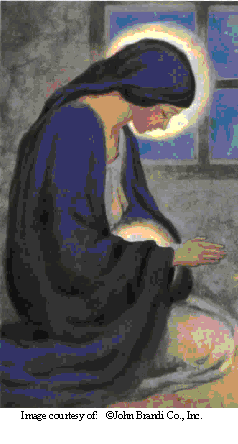
Historically it has been regarded both as a feast of Christ and Mary. From the various titles the day has been given over the years, we can see that some of the earliest (Feast of the Incarnation, Conception of Christ) and the recent Annunciation of the Lord put the emphasis on Jesus, while other titles like the Annunciation of the Blessed Virgin Mary and England’s Lady’s Day highlighted the role of Mary in assenting to God's will. The artwork on the opening page vividly illustrates how difficult and unnatural it would be to speak of the Unborn Christ without mentioning Mary. Whether or not one's spirituality encompasses a special love and respect for the Blessed Mother, all Christians can agree that for both Jesus and Mary, and the whole human race, the moment when God became man in the womb of a virgin in Nazareth is the most awe inspiring event of history and should be commemorated, especially today when prenatal life is under attack.
What year-round ideas can I use to promote the feast if the day has already passed?
If
you’ve missed the feast day you can still participate in and promote the feast
in several ways. Follow us on Twitter @March25info or the
Facebook AnnunciationDayMarch25 page for Annunciation-related news, TV specials,
seasonal web banners to share, and reminders for pro-life activities every 25th
of the month--including "25th of the Month Club" year-round suggestions and "9 Months
4 Life" Spiritual Adoption prayer (both described below). Many holidays have a historical link to the
Annunciation and provide an opportunity to send/post festive greetings
highlighting that link. See our year-round
listing of relevant Annunciation-related dates to promote awareness of the
day's import. Easter is the most timely
occasion since it usually falls less than a month after and is still the fourth
most popular holiday greeting card -- print, post and share our Easter-Annunciation
Card or, our Easter,
Annunciation and Good Friday banner which can be printed as a top-fold card
-- both note the traditional teaching that Christ was conceived and died on the
date of March 25th which would explain why the Annunciation feast of His
conception and the Easter feast of His Resurrection come at the same time of
the year. But the broadest and most
natural opportunity to promote the Annunciation at other times of the year is
the long Christmas/New Year holiday season from late November through early
January -- affording many occasions to point out the 9 month March 25/December
25 interval and the Annunciation as old New Year's Day. In addition to using the Christmas/New
Year's banners, to get an early start, share
the Virtual Advent Wreath link here http://dayoftheunbornchild.com/VirtualAdventWreath.htm from the start of the
Christmas season through December 25th as a quick, easy and fun way to
introduce people to "Annunciation Day"--the click-the-wick style
on-line wreath gives an Annunciation/Christmas greeting when the last candle is
"lit." Before and throughout
the holiday season see the "Highlighting
the Christmas Connection" section in our Ideas page
for opportunities and suggestions for using web
banners, cards, gifts, and all your December mailings to promote awareness
of the nine month link between the Annunciation and Christmas, and its
importance as the old New Year's Day.
Many other holidays and seasons have an Annunciation connection and the
web banners page has graphics with
themes as varied as springtime, April Fools' Day, tax season, the feasts of the
Blessed Mother's conception and birth in December and September, and even the
calendar itself -- all of which reference Christ's conception feast. But in any season you might suggest or offer
to help with an event for next year by contacting a local church or pro-life
group. Promoting the celebration of
"FirstDays" nine months before birthdays and sending out
"FirstDay" greetings is a related outreach that can be done anytime
reinforcing the idea of conception as a day to commemorate -- two of the
"Plus 9" and "FirstDay" graphics on the web banners page mention or allude to
March 25th -- the Remember to
Think Plus 9 banner and the Celebrate FirstDays
Like BirthDays banner. Whatever the
season, any Christian prayer group can propose the Annunciation as a focus of
thanks and praise for the gift of the Incarnation. Individuals can also introduce the theme into public prayer--for
example, if praying the Rosary
always remember to add a brief description when announcing the first joyful
mystery "The Annunciation" such as, "--when Christ was
conceived" or "--the Word was made flesh" or "--God became
flesh at Mary's yes" to provide a fuller appreciation of what happened on
that occasion and a more profound meditation.
Another option for groups of any size is to start a "Twenty-Fifth
of the Month Club" (locally or on-line with social networking)
dedicated to understanding and promoting the Annunciation and its connection to
Christmas year-round. "Spiritual
Adoption" may be the most popular way to observe the March 25 to
December 25 interval. Basically,
Spiritual Adoption is a nine-month gestational period of prayer for an unborn
child, in this case beginning on the Annunciation feast and ending at
Christmas. This can be done as an
individual or with others--use your own intentions or follow the "9
Months 4 Life" prayer journey from Annunciation Day to Christmas,
which includes general monthly pro-life intentions and monthly prayer petitions
for Spiritual Adoption. You may also be
able to join a church Spiritual Adoption program (the monthly intention may be
printed in the bulletin). Keep in mind
that this nine month Spiritual Adoption can be joined in progress. For example, if March 25th has only recently
passed, you might begin praying for an unborn child in the early embryonic
stage at risk from accidental harm whose mother may not yet know she is
pregnant, or for a child targeted by the abortion pill used early in
pregnancy. If the feast was two or more
months ago, pray for a child endangered by miscarriage or the common methods of
surgical abortion. If you begin in the
second half of the 9-month period following the feast (Aug.-Dec.), pray for a
child in danger from premature birth or late term abortion and
infanticide. You might choose your own
specific prayer intention for the child that changes every 25th of the
month. Click here
for more on “Spiritual Adoption” or click here
for a month-by-month list of Spiritual Adoption prayer intentions for
"Nine Months for Life."
To receive monthly "9 Months 4 Life" Spiritual Adoption prayer
intentions, "25th of the Month Club" tips, and "FirstDay"
reminders: click here to follow
March25info on Twitter, or make a monthly visit to the Facebook AnnunciationDayMarch25 page.
A Note on the Artwork (A Second Halo)
The
image on the home page was used by permission and is the property of John Brandi
Company--it
appears on their "Our Lady of The Millennium" prayer cards and art
prints. With its simplicity of
form, understated colors, and light emanating from Mary’s womb signifying the
hidden Christ, it is a beautifully poignant and thought-provoking depiction of
the mystery of the Incarnation.
Artistic renderings of this event are usually given the more broad title
of “Annunciation” which encompasses the three events of the angel’s
announcement, Mary’s consent, and the conception of Christ in her womb. The last of these, for obvious reasons, is
the hardest to represent. The dramatic
form of the archangel could easily detract from the unseen but all-important
culmination in the Word made flesh.
Traditional depictions showing Mary, the angel Gabriel, and the Holy
Spirit in the form of the dove are beautiful and instructive, but are only
correctly understood with guidance and meditation. For example, consider the recent experience of artist Michelle
Paine, speaking about her studies of art in Orvieto, Italy: "Particularly
of interest to me was the image of the Annunciation…this was an altarpiece...of
the angel Gabriel and Mary and the Holy Spirit, and this was something that I
thought about because I said, well, on the altar shouldn't there be Jesus -- where
is Jesus up there -- He is supposed to be -- Jesus is the center of
everything...so thinking particularly about the Annunciation,
eventually...realizing that is the moment of the Incarnation, and that little
Holy Spirit up there, coming in to Mary's womb, that's the moment that God the
Word becomes flesh, that God comes to earth." [Quote from: The Journey Home, EWTN, 7/18/16, 8 pm] Unfortunately some early attempts to
depict the Annunciation's Incarnational meaning in a more obvious way showed
the infant Christ descending to Mary’s womb--which is theologically erroneous
and aesthetically awkward.
By
contrast the relatively recent "Our Lady of the Millennium"
illustration chosen for this site beautifully blends both the natural and
supernatural elements of the scene. The
artist Barham’s use of drapery conceals from us the stage of Mary’s
pregnancy. Therefore it can represent
the whole span of Christ’s prenatal life in addition to the specific moment of
the Incarnation when Christ was conceived.
We often see halos used to identify angels and saints in art, but here
the scene's second halo, glowing around Mary's womb, subtly shows Christ the
Light of the World is present though not directly seen. This quietly elegant minimalist composition
is both reverent and modern in style.
As such it is a perfectly fitting emblem of the Incarnation and its
pro-life implications, as well as a potent reminder of the centrality of the
maternal-infant bond exemplified in history’s most contemplated and intriguing
mother-and-child relationship. [NOTE: There are several different paintings that
have the title “Our Lady of the Millennium.”
To find a retailer that carries the version used on this site see Further
Reading and Instructional Materials.]
Disclaimer: This website aims to collect useful information and links as a convenience only. No affiliation or endorsement in either direction of the individuals/organizations referenced or linked is implied.
[To return to home page click http://dayoftheunbornchild.com/ ]
Page Updated: 3/24/2022